 Morreene
Wave Clock: a ring of springs, folding
2024Giclée prints on archival paper
Sizes vary by work
These look like flowers, but nothing in the program knows what a flower is. There is a single ring made of springs. Every frame, a few of its springs are pulled a little shorter, and the ring folds in on itself. The picture is every shape the ring passed through, laid one on top of the next, about two thousand times.
The algorithm
Picture a loop of 400 beads on a table, joined to each other by short stiff springs so that they keep the shape of a circle. That is the rim.
Then each bead gets two longer, softer springs, the spokes, that reach across the circle to beads chosen at random on the far side. The spokes start out longer than the circle is wide. So at first they push outwards, and the ring stays open.
Now the program runs, one frame at a time:
- Shorten some spokes. Pick 400 spokes at random and make each one a little shorter, by a random amount. Some spokes get picked twice and some not at all, so one bead is pulled in hard while its neighbour is left alone.
- Let the springs settle. A small physics engine moves every bead according to the springs pulling on it. The rim tries to stay a smooth loop. The spokes drag parts of it inwards. The loop buckles.
- Draw the ring. Its outline is drawn as a thin, almost transparent line, and its inside is washed lightly with white.
- Go back to step 1.
Because the spokes join beads that are far apart on the loop, the ring can't simply shrink. It crumples. Lobes fold over each other and twist. Over two thousand frames it collapses from a wide circle down to a tight knot in the middle.
That is the whole drawing. The early frames, when the ring is still large, make the outer petals. The late frames, when it has crumpled small, make the centre. So the picture is also a clock: you are looking at the whole run at once, with the beginning on the outside and the end in the middle.
Where the colour comes from
The colour is time, too. Each frame's line is drawn in a hue that drifts a little from the frame before, and it gets slightly deeper as the run goes on. The first frames set the colour of the outer edge. The last ones set the colour of the core. In between, the colour changes gradually from one to the other.
The starting hue comes from the random seed, so each image picks its own colour. In the blue piece below, the run starts at turquoise and drifts through blue to violet. In the rose piece it starts at hot pink and drifts through red and orange to a pale yellow centre.
The white wash is what carves the petals
Step 3 hides the most important rule. Each frame, the inside of the ring is washed with white, and that wash covers some of the ink that the earlier frames put down. Without it, two thousand overlapping outlines would fill in as one solid blot. With it, the only ink that survives is ink laid down near the edge of the ring after that spot was last covered. That is what leaves the thin, layered, silk-like folds.
Where it started
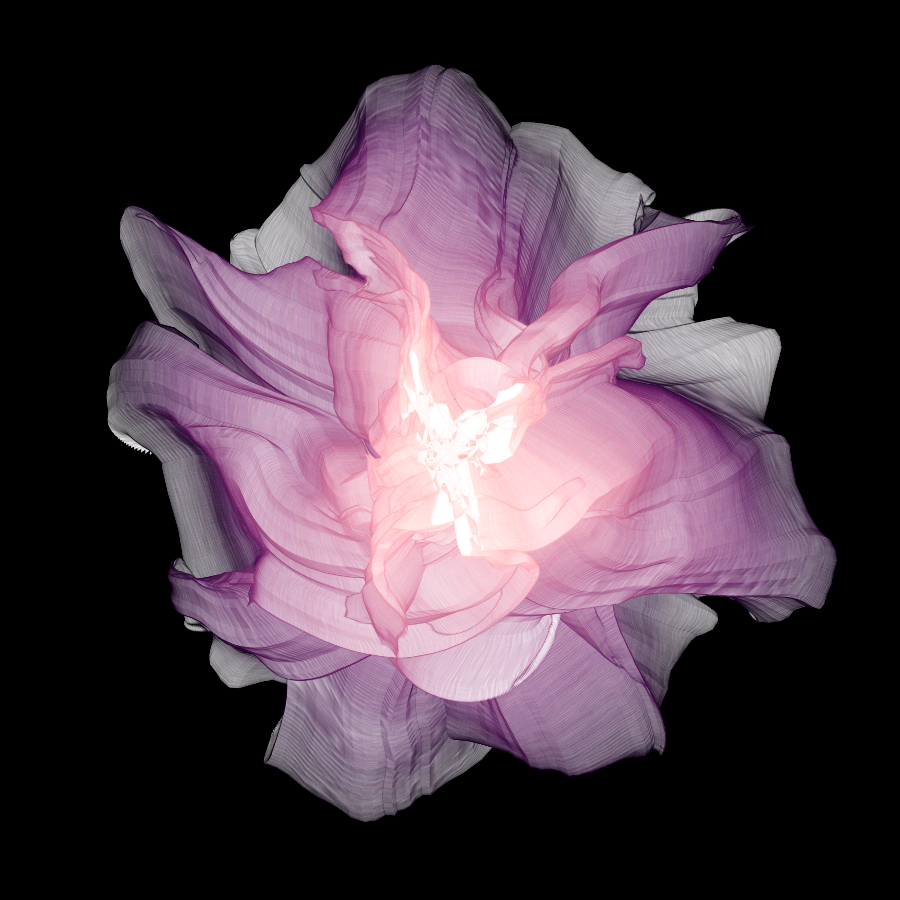
The first version, 2014. Light ink on black.
The first version was a short Processing sketch from 2014, using the traer.physics library for the springs. It drew in light on a black ground, so each petal glowed outwards and the centre burned white.
For the new pieces I rebuilt it so that it can be printed:
Ink on paper instead of light on black. The ground is now white, and the brightness of the line runs the other way. It starts light and darkens as the run goes on, so the ink settles onto the paper instead of glowing out of the dark.
A closed centre. Over the last frames the springs are drawn in further, so the ring closes to a point. The bloom now has a knot at its centre instead of a ragged hole.
Every image can be made again
Each image comes from a random seed and a list of settings, and the file name records all of them. Give the program the same file name and it folds the same ring in the same way, frame for frame. So I can look through hundreds of seeds at preview size and keep the ones worth printing. Then I render those at full size and the composition does not change.
The physics is what makes that possible at any size. If every length in the system is doubled (the ring, the springs, the amount they shrink each frame) the beads follow exactly the same paths, twice as large. A large print is the same bloom as the preview, only with more detail.
Blue
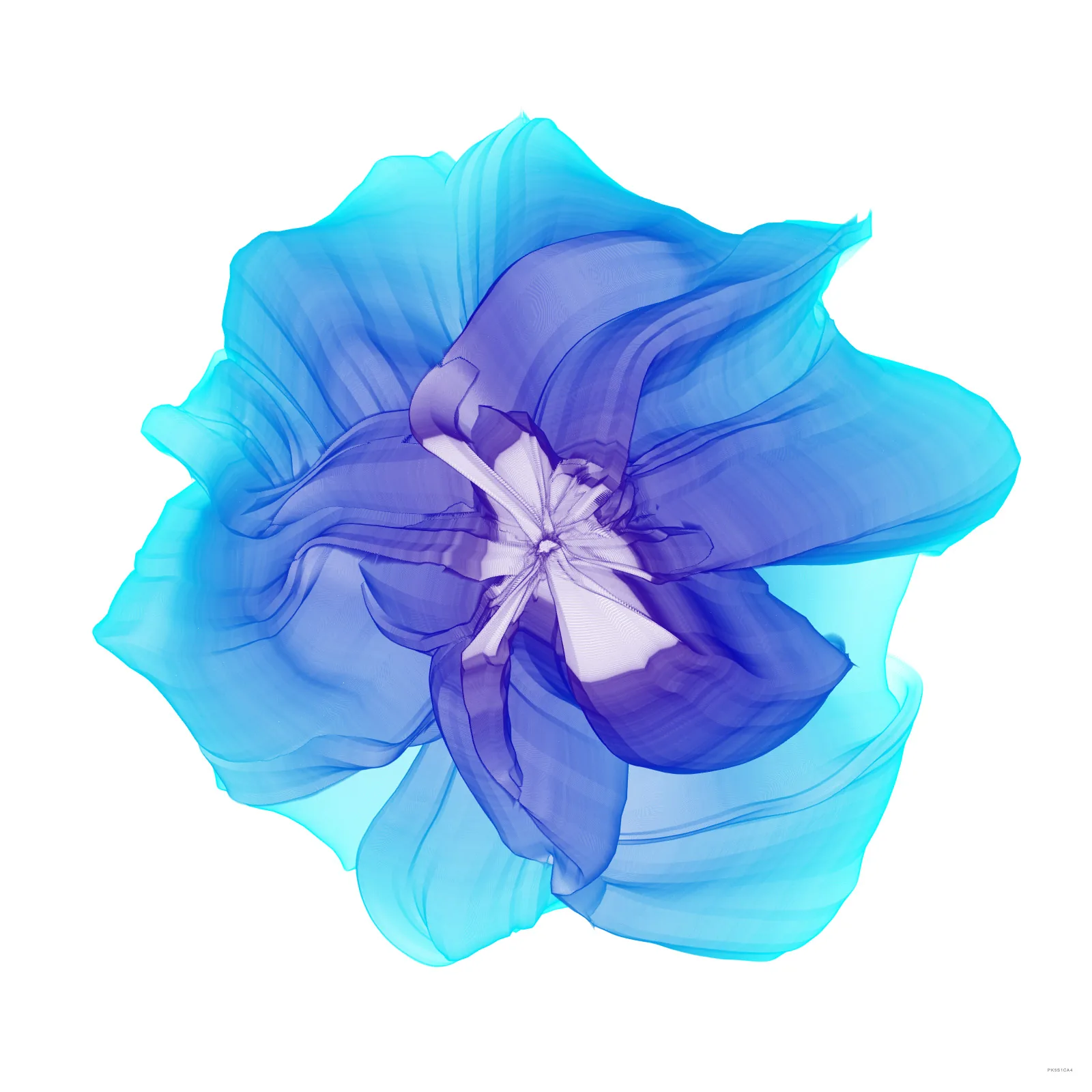
50 × 50 cm.
The run starts at turquoise, so the wide outer petals are pale sea colours. As the ring crumples it moves through cobalt to a deep violet. The pale lilac shapes in the centre are where the last, large washes cleared the paper and only a few late lines landed on top.
Rose
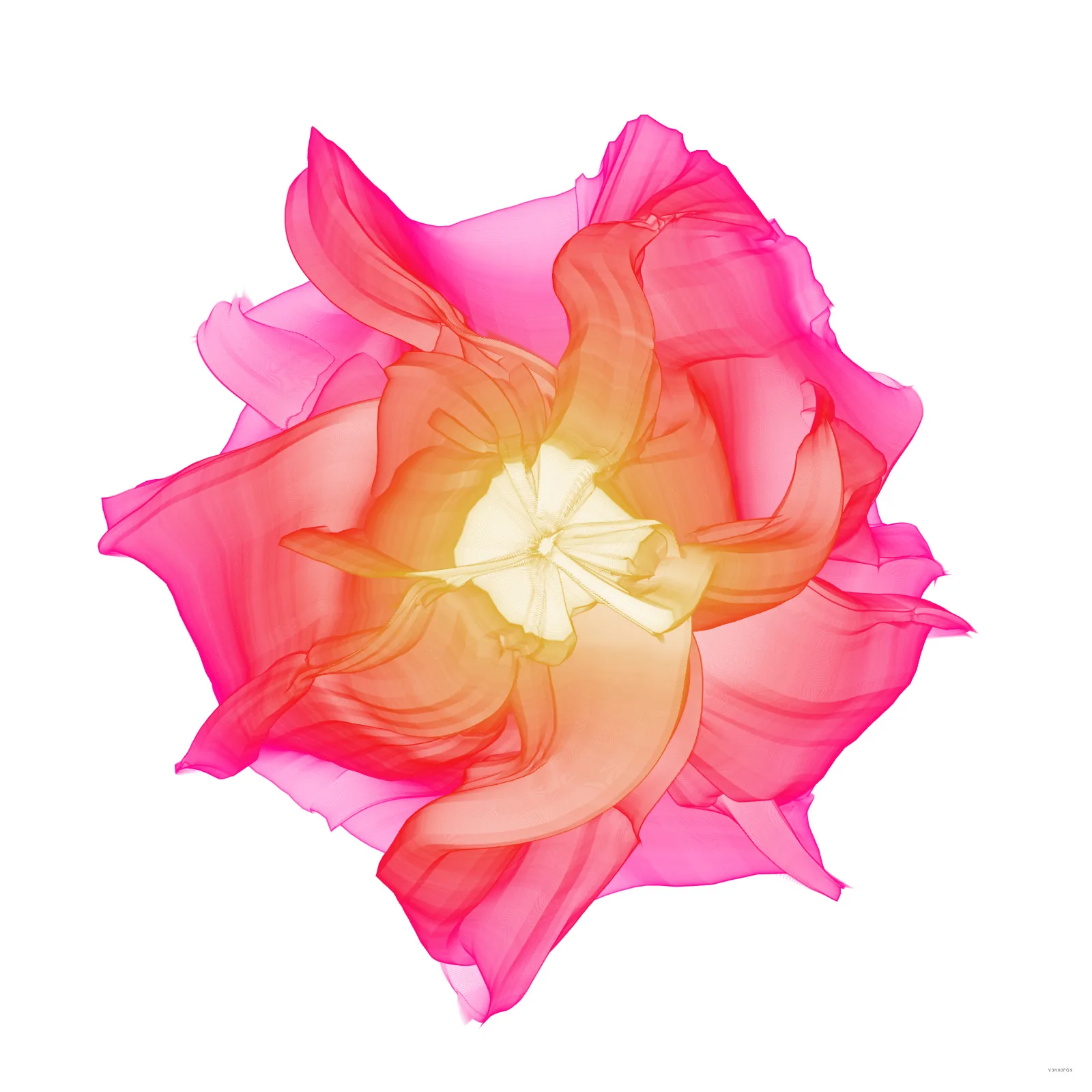
50 × 50 cm.
The warm counterpart. The outer petals are hot pink. The folds deepen to red and then turn orange as the ring closes in. The centre is a soft yellow, like the inside of a tulip.
Wave Clock is made in Processing, with the traer.physics library for the springs.