 Morreene
Raw Silk
2024Giclée prints on archival paper
Sizes vary by work
Notes on ten thousand threads that never touch
Nothing in this image was drawn. There is a field of angles covering the page — invisible, unpaintable, just a direction assigned to every point — and then there are thousands of particles released into it, each one doing the only thing it knows how to do: look down, see which way the ground is pointing, take a step, look again.
The field comes from Perlin noise, the soft drifting randomness used to fake clouds and marble, read here not as brightness but as bearing. Turn the noise value into an angle and the plane acquires a grain, like brushed metal or a river seen from an aeroplane. On its own there is still nothing to look at. A flow field is a claim about motion, and a claim about motion is only visible once something moves.
The particles are stupid on purpose. No memory, no goal, no awareness of each other. They cannot avoid a neighbour or seek out empty space, and every braid and knot in the finished piece was made by things that never once acknowledged one another's existence. That is the part I find hard to stop thinking about.
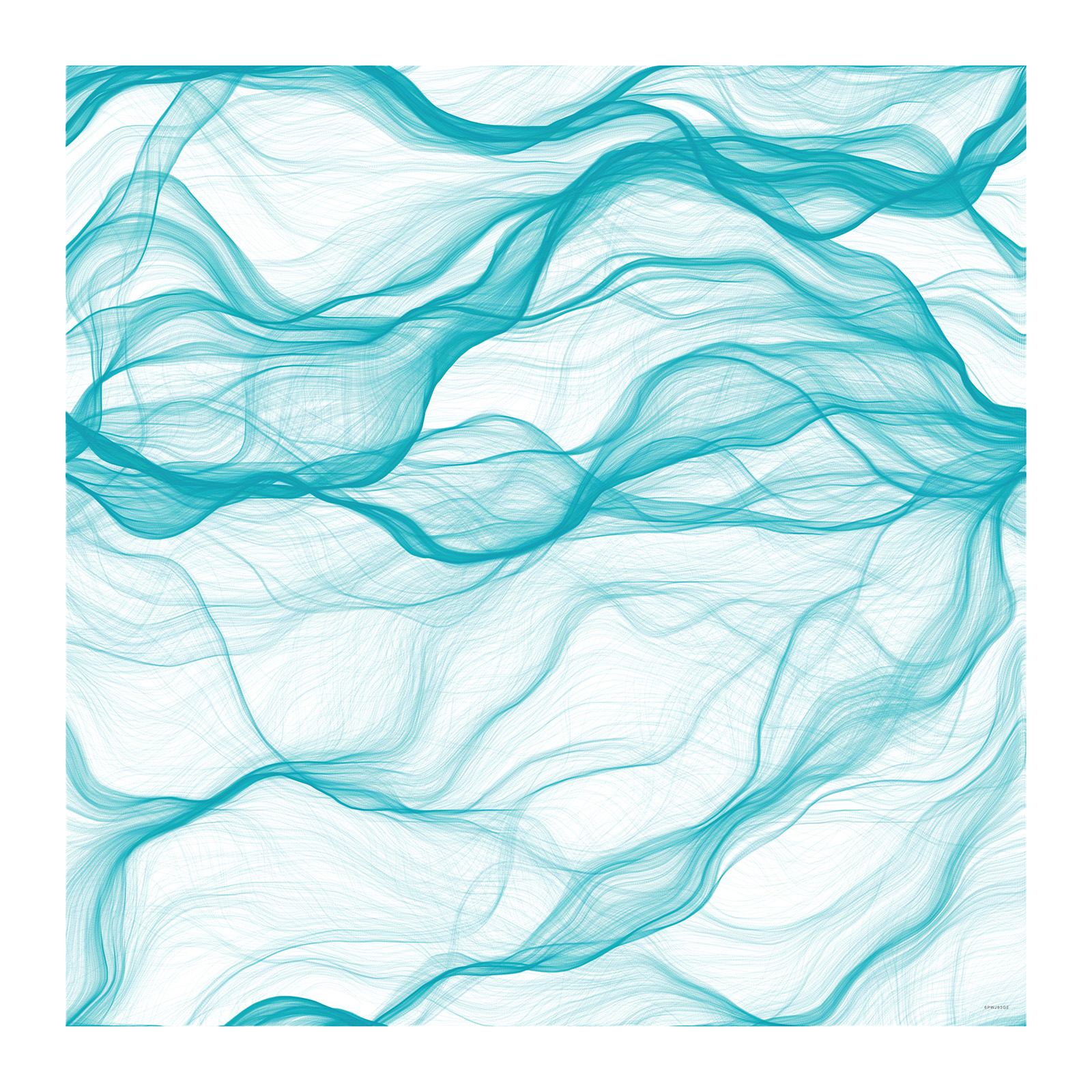
What makes it look like fabric rather than a diagram is the ink. Each particle lays down green at an alpha so low that a single pass is functionally invisible — you could run one particle across the whole page and photograph the result and it would still be a white square. Tone only exists as accumulation. Every value in the image is a count: this is how many times something came through here. The dark filaments are not lines, they are congestion. The pale wash is thin traffic. I never chose where anything would be dark.
Which means the image develops rather than appears. On a white ground, with pigment stacking pass over pass, it behaves almost exactly like a watercolour wash — the same slow deepening, the same way an edge sharpens because the flow ran along it twice as often as through it. I let it render in front of me more often than I should. It is not efficient and it is not necessary, but a picture that arrives all at once and a picture that arrives over four minutes are not the same picture to the person making it.
The scale of the noise is the one dial that decides everything, and it is unforgiving in both directions. Too fine, and the particles turn constantly, the strokes never get anywhere, and the page looks like wet fur. Too coarse, and the whole field points more or less one way; the particles march in parallel and produce combed, obedient stripes with nothing to look at. The interesting band is narrow. In it the field has long channels and turbulence, so a thread can run half the width of the page and then be caught, folded, and sent back across itself.
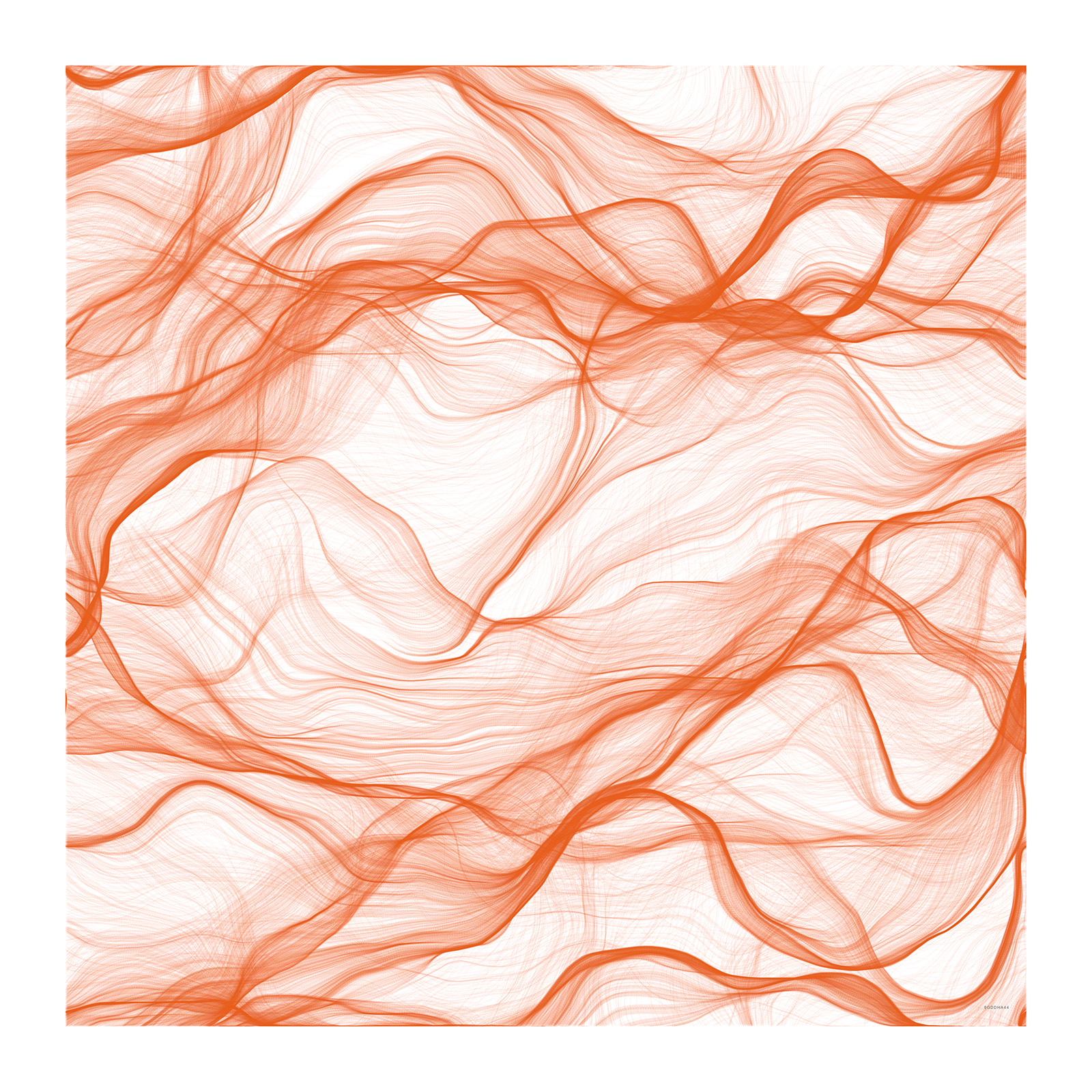
The mistake I made for a long time was over-feeding it. Great channels in the field act as attractors: release enough particles and nearly all of them get swept into the same few, which go black while the rest of the page stays bare. My instinct was more particles, which made it worse — more ink into the same drains. The fix was the opposite. Fewer steps per particle, and far more of them, scattered and killed young. The page fills evenly not because anything travels further but because more things begin in more places.
So the ink isn't the work, and neither are the particles. They are a readout. The field was already there, complete, before anything moved through it — a shape with no way of being seen until something drifted across it and left a mark.
Made in Processing.